‘They Even Lie About This?’: Karoline Leavitt Tries to Rewrite History, Credits Trump with Inventing Slogan Created By a Black Man Two Decades Ago
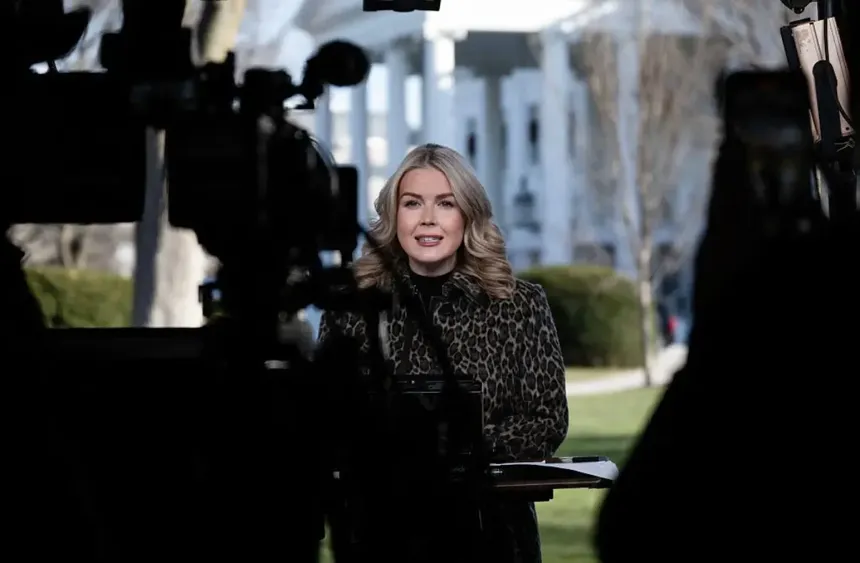
White House Press Secretary Karoline Leavitt tried to credit President Donald Trump with a political slogan he didn’t invent—leaning into yet another false claim that lasted about as long as it took to check the facts. While promoting the president’s energy agenda earlier this week, Leavitt declared that Trump had “made up the phrase ‘drill, baby, drill.’” US White House Press Secretary Karoline Leavitt does a TV interview outside the White House in Washington, DC, on December 16, 2025. (Photo by ANDREW CABALLERO-REYNOLDS / AFP via Getty Images) The problem is, the expression predates Trump’s second term in office by nearly two decades and remains firmly lodged in the cultural memory of the George W. Bush era. Leavitt, 28, made the assertion Monday during a round of television interviews outside the White House, crediting Trump with coining the phrase as part of his current push for expanded domestic power production. Video of Leavitt's remarks immediately drew ridicule, largely because the slogan’s origins are among the most well-documented artifacts of modern politics. ‘What a Disgrace’: JD Vance Shunned in His Ohio Hometown as Residents Embarrassed By His Vice Presidency and Trump Promises Fell Apart “Drill, baby, drill!” first emerged as a rallying cry during the 2008 Republican National Convention, where it was introduced by then–Maryland Lt. Gov. Michael Steele, who would later become chairman of the Republican National Committee. https://twitter.com/atrupar/status/2001007399419654505 The chant quickly spread through the party and reached peak saturation in 2008 after it was embraced by then-Alaska Gov. Sarah Palin, the GOP’s vice-presidential candidate alongside Senator John McCain, the Republican nominee. She used the popular phrase during the debate against then–Senator Joe Biden, whom Democratic nominee Barack Obama selected as his running mate. “The chant is ‘drill, baby, drill,’” Palin said on the debate stage, cementing it as one of the election cycle’s defining sound bites. Trump has since adopted the phrase like it’s going out of style, deploying it repeatedly during the 2024 presidential campaign, at the 2024 Republican National Convention, and again during his Jan. 20, 2025, inaugural address. “We will drill, baby, drill,” he declared. Still, no one had forgotten the words of Steele and Palin, and the passage of time did nothing to turn Leavitt’s claim into anything more than a hill of beans. Reaction to Leavitt’s dishonesty spared no criticism, drawing widespread mockery across social media. “Someday they’ll claim that Trump invented the punctuation mark,” one critic wrote on X. “They even lie about this? Did he invent gravity too?” another remarked. One response cut straight to the bottom line. “It’s amazing how easy it is for this administration to lie.” Republicans continued to use “drill, baby, drill” well after the 2008 election cycle, but the slogan’s shine dulled dramatically in 2010 following the Deepwater Horizon disaster, when an offshore drilling rig exploded in the Gulf of Mexico. The spill caused extensive environmental damage and economic losses estimated in the billions. Following the disaster, “drill, baby, drill” was mocked as “spill, baby, spill” and “kill, baby, kill,” prompting several prominent Republicans to publicly distance themselves from it. Still, Trump has resurrected the chant as a centerpiece of his policy rhetoric, aided by a press team seemingly willing to rewrite history to give him credit. Leavitt’s episode also fits neatly into a broader pattern: Trump’s repeated false claims that he has personally coined words and phrases that long predate him. Among them is “caravan”—a centuries-old term Trump insisted he invented to describe migrant groups traveling north, claiming: “The caravan. I made up that name too. I’m good at names.” “They would put them in the—in these massive large caravans. I came up with that name a long time ago. That’s what it is. It’s a caravan. And these are people—in many cases, they might not be criminals, but they’re people that the country didn’t want.” Trump’s fascination with his own supposed linguistic genius resurfaced again back in May when he signed an executive order giving prescription drug manufacturers 30 days to lower prices. While explaining the policy to reporters, the president paused to marvel at what he presented as a personal breakthrough in the English language. “Basically, what we’re doing is equalizing. There’s a new word that I came up with, which is probably the best word,” he said. “We’re gonna equalize, where we’re all gonna pay the same. We’re gonna pay what Europe’s gonna pay.” As dictionaries attest, Trump did not invent “equalize,” either. Merriam-Webster traces the word’s first known usage to 1599, and Trump himself has used it multiple times in the past, including in his March 5 address to a joint session of Congress. An avalanche of online criticism poured ice water on Trump’s nonsense. “It's easy for Trump to think he created the word Equalize in that we should all pay equal when he is the person who brought the curve down his entire life,” one critic wrote. “I bet other students were pleased to see Trump in the class when professors said grading would be on a curve.” One person used the moment to turn Trump’s language back on his own agenda, with one critic asking, “How about equalizing the taxes billionaires and corporations pay to those the rest of us do, on a percentage basis of course.”